Arnaud Legoux Moving Average (ALMA)
| Name | Type | Prerequisite | Use Cases |
|---|---|---|---|
| Arnaud Legoux MA (ALMA) | Trend | OHLC Data | Superior trend tracking that filters "noise" without sacrificing timing. |
Definition
The Arnaud Legoux Moving Average (ALMA) is a moving average designed to reduce lag associated with traditional moving averages while preserving responsiveness and smoothness. It uses a Gaussian distribution to weight the prices in the moving window, allowing the user to control the offset (lag) and the width (sigma) of the distribution.
Mathematical Equation
ALMA applies a weight to the price at time \(t-i\) according to a Gaussian function:
Where:
-
\(i\) ranges from 0 to \(N-1\) (window size).
-
\(\text{offset} = \text{floor}(\text{offset\_fraction} \times (N - 1))\).
-
\(\sigma\) controls the width of the filter.
The ALMA value is the weighted sum of prices:
Special cases
- Maximum possible value: Unbounded (Follows Price)
- Minimum possible value: Unbounded (bounded by 0)
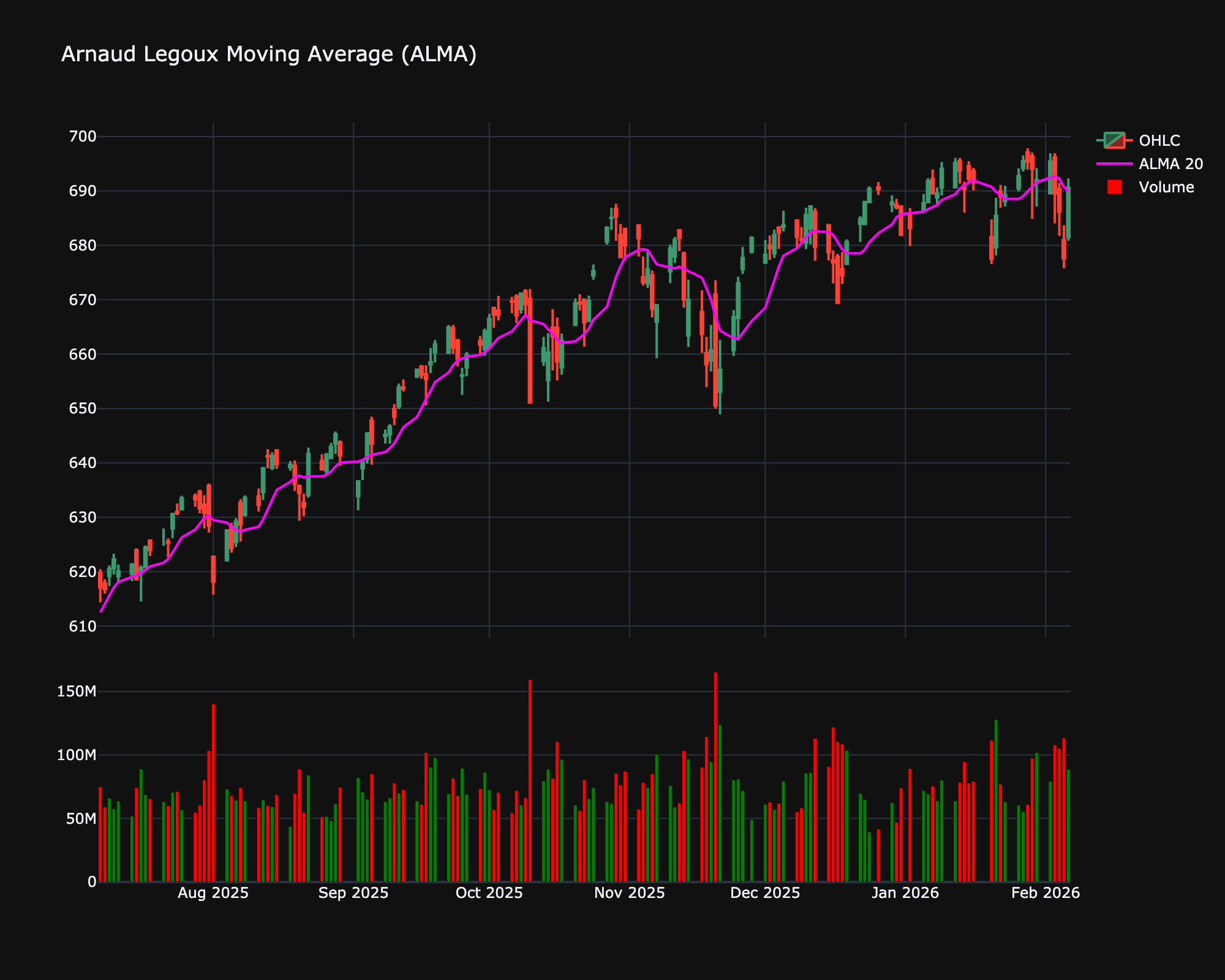
- Behavior: Follows the price like moving averages, acting as a smoother trend-following indicator with reduced lag. Plotted on the price chart.
Visualization
Trading Significance
-
Trend Identification: Like other MAs, ALMA helps identify the trend direction. An uptrend is indicated when price is above ALMA, and downtrend when below.
-
Reduced Lag: ALMA is often preferred over SMA or EMA because it hugs the price action closer without introducing excessive noise, making it effective for signal generation in shorter timeframes.
-
Support/Resistance: It frequently acts as dynamic support or resistance.