Ultimate Oscillator
| Name | Type | Prerequisite | Use Cases |
|---|---|---|---|
| Ultimate Oscillator (UO) | Momentum | OHLC Data | Reducing false overbought/oversold signals. |
Definition
The Ultimate Oscillator (UO) was developed by Larry Williams. It combines short-term, intermediate-term, and long-term timeframes into a single oscillator. By using weighted averages of three different timeframes, it aims to reduce false signals.
Mathematical Equation
It calculates Buying Pressure (BP) and True Range (TR) for 7, 14, and 28 periods.
\[
UO = \frac{4 \times Avg_7 + 2 \times Avg_{14} + 1 \times Avg_{28}}{4+2+1} \times 100
\]
Where \(Avg_N = \sum BP_N / \sum TR_N\).
Special cases
- Maximum possible value: 100
- Minimum possible value: 0
- Behavior: Oscillates between 0 and 100 by combining short, medium, and long-term momentum.
Visualization
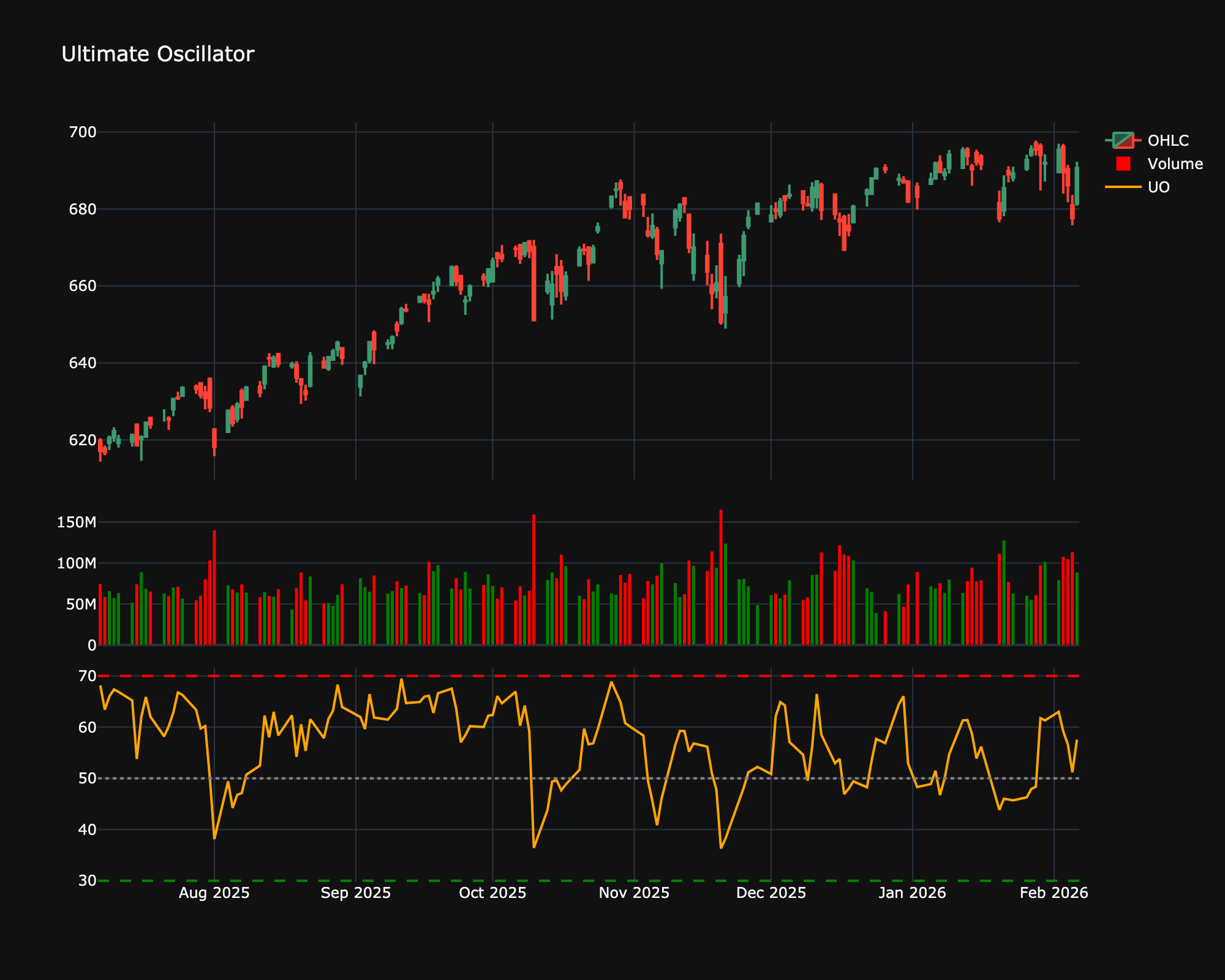
Trading Significance
-
Buy Signal: Bullish divergence (price lower low, UO higher low) when UO is below 30, followed by a breakout above the divergence high.
-
Sell Signal: Bearish divergence (price higher high, UO lower high) when UO is above 70, followed by a breakdown.
-
Overbought/Oversold: Levels < 30 are oversold; > 70 are overbought.